I’m Mint Achanaiyakul, a cognitive theorist, founder, and lifelong learner. My interests span the mind, language, science, culture, movement, and the connections between them.
Fig. 0.1 — The learner, orbited by subjects. Portrait area reserved.
01 — The Curious Mind
start with a question
PhotographTo come · 4 : 5
Fig. 1.1 — Caption to come.
I was born in Bangkok, spent my first four years in California, and grew up in Bangkok. I’ve always loved education, but no single curriculum has ever contained everything I wanted to learn.
I’m a cognitive theorist and founder of Psychomedia. My work explores how language, media, and culture shape memory, identity, and responses to trauma. Psychomedia developed from my long-term study of the subconscious, the architecture of the mind, symbolic conditioning, and mass-media influence.
That curiosity also runs through dance, sports, music, languages, and the experiences I create to bring people together.
I take education seriously. My curiosity doesn’t stop at the edge of a curriculum.
02 — How I Think
I look beneath the surface: questioning assumptions, tracing connections, and building explanations across disciplines. The process is rarely linear—a new discovery can send me back to rethink the question.
The anatomy of a questionIt starts with an obsession.
Psychomedia.
One field that grew from this approach. Other questions lead elsewhere.
The developing educational home of Psychomedia, bringing together proposed curricula, course outlines, and foundations for studying the field. A platform for future teaching and academic collaboration.
psychomediaglobal.com
LanguagesWebsite in development
Polyglot Mint
A creative project dedicated to multilingual speaking, singing, and performance, exploring the expressive possibilities of different languages.
polyglotmint.com
05 — Languages as Lenses
same word, new world
Choose a language to read its story.
In my lifeEnglish
Fig. 5.1 — The languages I use, study, and keep returning to.
06 — The Path So Far
A record in progress
07 — Where This Leads
Some questions become research papers.
Others become projects, new skills, or experiences I never expected to pursue.
AI-generated illustration · Creative direction by Mint Achanaiyakul
01Abstract
This essay traces one autobiographical root of Psychomedia: the books I read too young, and the inner world they trained. Reading Chuck Palahniuk, Natsuo Kirino, and Truman Capote at twelve taught me that stories do not merely entertain. They shape attention, normalize emotional climates, redirect empathy, and quietly train what the mind accepts as real. This is a personal record of how stories taught me to question stories.
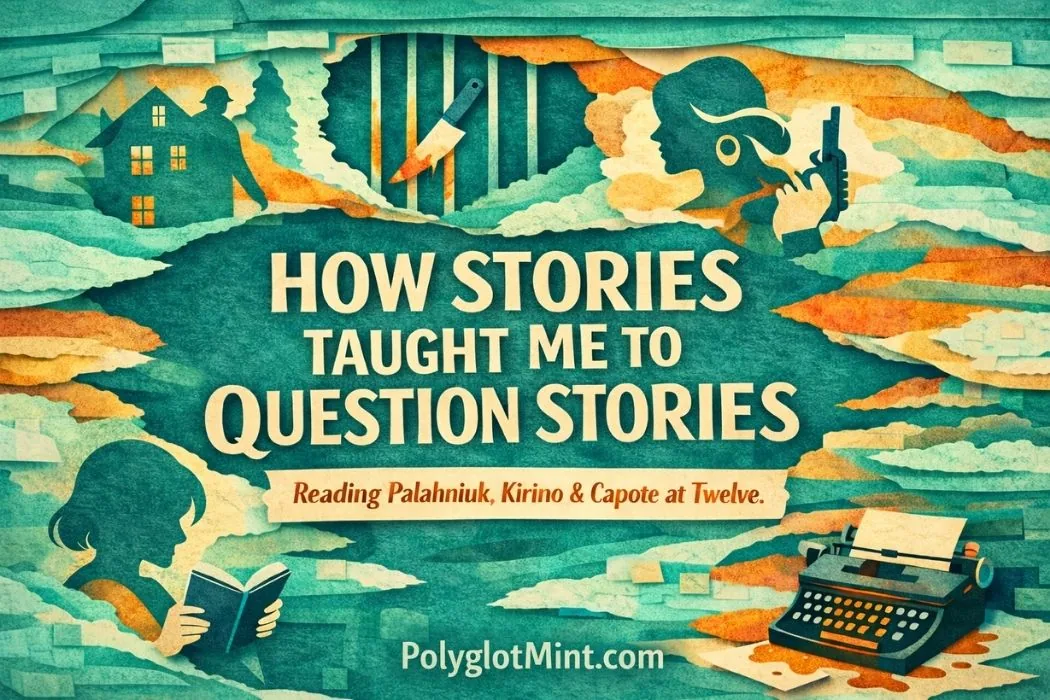
02How Stories Taught Me to Question Stories
I didn't grow up on young adult fiction. I skipped straight from children's books into the deep end: Chuck Palahniuk, Natsuo Kirino, and Truman Capote. While other kids were reading about locker drama and first crushes, I was reading about cults, dismemberment, psychopaths, and murderers written in sentences so beautiful they felt narcotic. That was my media diet at twelve.
My dad let me buy anything. No one checked the blurbs or previewed the pages. If I could carry the book to the counter, it was mine. I wandered through crime, horror, and science shelves, grabbing whatever looked intense or intelligent. I didn't just want stories. I wanted to know everything. That freedom shaped my taste, but it also trained my nervous system. According to Green (2004) in The Role of Transportation Into Narrative Worlds↗ (external link, opens in a new tab), narrative transportation involves cognitive, emotional, and imagery-based immersion; according to Appel and Richter (2010) in Transportation and Need for Affect in Narrative Persuasion↗ (external link, opens in a new tab), that kind of immersion can make stories persuasive in ways readers do not fully register at the time. I did not know the theory then. I only knew that books could get inside me.
03What Haunted trained first
Palahniuk's Haunted was the first book that felt truly exhilarating and horrifying at the same time. I remember the woman realizing she had been eating her own body, and instead of slamming the book shut, I kept reading with adrenaline in my chest. It was disgusting and thrilling in the same breath. In the larger story, a psychopath traps a group of writers in a house, dangles the promise of fame, and watches their minds and morals collapse as they starve and compete. They go insane slowly, and the reader is entertained the whole time.
I was reading Haunted at Harrow, awkward and depressed, walking between classes with girls I couldn't really feel. I was numb most of the time. My books were my real companions. I remember offering to lend it to a few girls on the way to class. One of them seemed interested until I described how disgusting it was. In hindsight, that memory is almost too perfect. I was a child carrying industrial-strength horror around like it was normal bonding material.
What Haunted trained first was not just tolerance for extremity, but attraction to it. Shock became fused with curiosity. Disgust became fused with pleasure. Humor also started doing something darker. It softened the moral edge of what should have repelled me and made it easier to stay inside the spectacle. That is close to what I now call Laughter Consent†: the moment laughter behaves like permission and tells the nervous system, "this is safe, this is normal, this is allowed." The novel also revealed something I would keep seeing later in media: put people in confinement, strip away comfort, add scarcity, add status competition, and morality becomes negotiable while the audience keeps watching.
04What Grotesque made visible
If Palahniuk stretched my tolerance for extremity, Kirino's Grotesque rewired how I saw envy, beauty, and truth. The book traps the reader inside the mind of a woman dissecting her younger sister, a girl so beautiful she feels almost inhuman. The narrator sounds sharp, wounded, and observant. I believed her at first. But I was also an Asian girl who had spent years envying "halfie" girls — the girls who got scouted for modeling, the girls men noticed, the girls who seemed to carry a different kind of social gravity. So reading Grotesque felt uncomfortably familiar. I recognized the narrator's resentment because some version of it had already lived in me.
Reading Grotesque, I recognized my own fantasies and resentments in the narrator. I wanted beauty, desirability, and power; I also resented the social economy built around them. Kirino gave me a mind that could turn injury into superiority and bitterness into narrative authority. Then she refused to excuse it. Slowly, the "observant" sister starts to look less like the moral witness and more like the predator.
That mattered. Grotesque taught me that you cannot trust a narrator just because she sounds articulate and hurt. Pain can sharpen perception, but it can also weaponize it. The book also taught me that beauty and desirability are rarely neutral social facts. They become loaded with rivalry, fantasy, humiliation, status, and resentment, and once that loading happens, perception stops being clean. Whoever controls the voice controls reality. Whoever holds the microphone can erase other people's humanity and still sound intelligent doing it. That pattern would later matter enormously to me in thinking about media, gender, race-coded desirability, and victimhood as performance.
05What In Cold Blood did to moral attention
Capote's In Cold Blood pushed everything into ethics. Asia Books was running a promotion and giving away free titles. My dad didn't believe it, but I walked in, picked In Cold Blood off the table, and walked out with it. By the time I finished, I remember crying when the killers were executed. I was not crying for the murdered family. I was crying for the men who killed them. That is how far my empathy had been guided by the story's framing.
Capote taught me that narrative framing is moral engineering. Which scenes get attention, which details get atmosphere, and whose interiority the reader is allowed to inhabit will change who feels legible, who feels human, and who quietly recedes. Calm, elegant language can feel neutral while doing enormous emotional work under the surface. According to Decety and Cowell (2014) in Friends or Foes: Is Empathy Necessary for Moral Behavior?↗ (external link, opens in a new tab), empathy and morality are related but not identical. That distinction matters here. A story can intensify empathic access to a person without solving the moral question of what they have done. In Cold Blood taught me that attention is power, and that the spotlight can rearrange justice inside the reader long before the reader notices it happening.
06Why this became Psychomedia
Taken together, these were not just edgy books I read too young. They were early training modules in what I would eventually name Psychomedia: the psychology of media, trauma, and control. Palahniuk taught me how shock, humor, and confinement can make horror feel exhilarating. Kirino taught me how envy, beauty, and narrative voice can distort perception while still sounding honest. Capote taught me that the way a story is framed can quietly rewrite empathy and moral judgment.
That is how stories taught me to question stories. This Mint's Life story is also a small case study in cognitive world-building†: the books I wandered into at twelve built inner worlds where horror could feel fun, beauty could feel dangerous, and killers could feel sympathetic. Psychomedia is the field I built to study that process on purpose, so people can see the machinery before it finishes rewriting them.
This essay situates one autobiographical root of Psychomedia in lived reading experience: not only what stories say, but what repeated exposure trains the nervous system to enjoy, excuse, fear, or admire.
Mint Achanaiyakul is a cognitive theorist and founder of Psychomedia. Her work explores how language, media, trauma, and systems of control shape human psychology.