I’m Mint Achanaiyakul, a cognitive theorist, founder, and lifelong learner. My interests span the mind, language, science, culture, movement, and the connections between them.
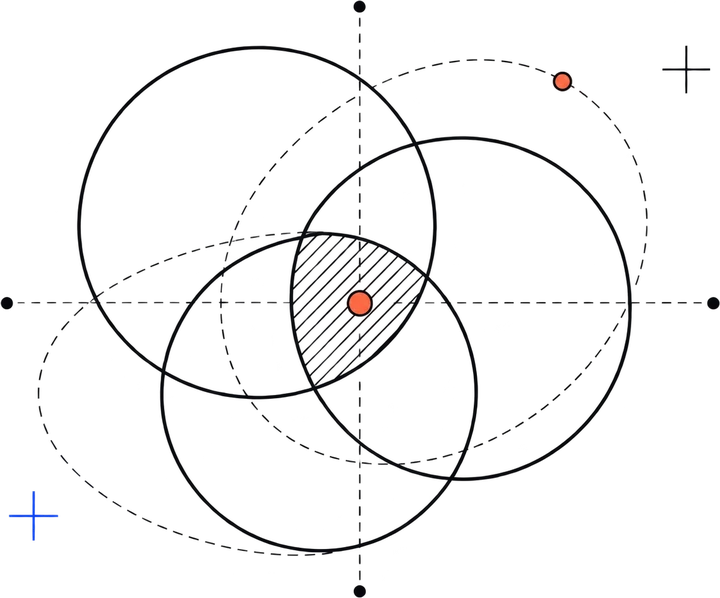
Fig. 0.1 — The learner, orbited by subjects. Portrait area reserved.
01 — The Curious Mind
start with a question
PhotographTo come · 4 : 5
Fig. 1.1 — Caption to come.
I was born in Bangkok, spent my first four years in California, and grew up in Bangkok. I’ve always loved education, but no single curriculum has ever contained everything I wanted to learn.
I’m a cognitive theorist and founder of Psychomedia. My work explores how language, media, and culture shape memory, identity, and responses to trauma. Psychomedia developed from my long-term study of the subconscious, the architecture of the mind, symbolic conditioning, and mass-media influence.
That curiosity also runs through dance, sports, music, languages, and the experiences I create to bring people together.
I take education seriously. My curiosity doesn’t stop at the edge of a curriculum.
02 — How I Think
I look beneath the surface: questioning assumptions, tracing connections, and building explanations across disciplines. The process is rarely linear—a new discovery can send me back to rethink the question.
The anatomy of a questionIt starts with an obsession.
Psychomedia.
One field that grew from this approach. Other questions lead elsewhere.
The developing educational home of Psychomedia, bringing together proposed curricula, course outlines, and foundations for studying the field. A platform for future teaching and academic collaboration.
psychomediaglobal.com
LanguagesWebsite in development
Polyglot Mint
A creative project dedicated to multilingual speaking, singing, and performance, exploring the expressive possibilities of different languages.
polyglotmint.com
05 — Languages as Lenses
same word, new world
Choose a language to read its story.
In my lifeEnglish
Fig. 5.1 — The languages I use, study, and keep returning to.
06 — The Path So Far
A record in progress
07 — Where This Leads
Some questions become research papers.
Others become projects, new skills, or experiences I never expected to pursue.
Psychomedia studies media as a psychological environment — one that shapes perception, emotion, memory, and identity.AI-generated illustration · Creative direction by Mint Achanaiyakul
Psychomedia is the psychology of media, trauma, and control.
It studies how media does more than inform, entertain, or distract. Media shapes what people notice, what they feel, what they remember, what they deny, and what they become.
Most people think of media as content: films, news, posts, images, music, feeds, advertisements, algorithms, stories. Psychomedia looks at media as an environment. It asks what happens when a person lives inside repeated symbolic input long enough for it to shape perception, emotion, identity, and nervous-system response.
01Why Psychomedia Matters
Media is not neutral.
A person does not simply "watch" media and remain unchanged. The nervous system responds. Attention is pulled. Emotion is activated. Fear, desire, shame, urgency, longing, disgust, and belonging can be trained through repetition.
Over time, repeated media patterns can begin to feel like reality itself.
Psychomedia studies this process. It looks at how symbolic environments influence the inner world: not only what people believe, but what they are able to feel, remember, imagine, or question.
02Media as Psychological Environment
A psychological environment is anything that repeatedly shapes how a person experiences the world.
Family can be a psychological environment. School can be a psychological environment. Religion, language, politics, advertising, entertainment, and social media can also become psychological environments.
Psychomedia focuses on the symbolic layer of that environment.
It asks questions like:
How does media teach people what is normal?
How does repetition make certain emotions feel natural?
How do stories train desire, fear, shame, or denial?
How do images shape the body's sense of safety or threat?
How do platforms reward some states of mind and punish others?
When media becomes environment, it does not only deliver information. It trains the conditions under which the mind interprets reality.
03Trauma, Language, and Control
Psychomedia is especially concerned with trauma because trauma changes how the mind processes meaning.
A traumatized nervous system may scan for danger, avoid certain memories, shut down feeling, cling to familiar patterns, or repeat painful states that feel impossible to leave. Media can interact with those patterns.
It can soothe them. It can exploit them. It can normalize them. It can deepen them.
Language matters because language gives trauma a structure. Words can reveal experience, but they can also hide it. A culture can use language to name pain clearly, or to make pain disappear.
Control matters because media systems can shape what people are allowed to perceive. Control does not always look like force. Sometimes it looks like distraction, repetition, emotional exhaustion, spectacle, false urgency, or the constant replacement of reflection with reaction.
Psychomedia studies how these forces work together.
04What Psychomedia Studies
Psychomedia studies the relationship between symbolic input and psychological state.
It does not replace psychology, neuroscience, media studies, linguistics, or trauma theory. It connects them through one central question:
What happens to the mind when media becomes part of the environment that forms it?
05Psychomedia Is a Field, Not Just a Topic
Psychomedia is not just "media affects people."
It is a field for studying how media systems interact with the mind over time.
A single movie, post, song, or image may matter. But Psychomedia is most interested in patterns: repeated exposure, repeated emotional states, repeated language, repeated symbols, and repeated cultural instructions.
It looks at how those patterns become internal.
Psychomedia as a field: media, language, trauma, and symbolic systems mapped as one connected system rather than separate topics.
The simplest way to understand it is this:
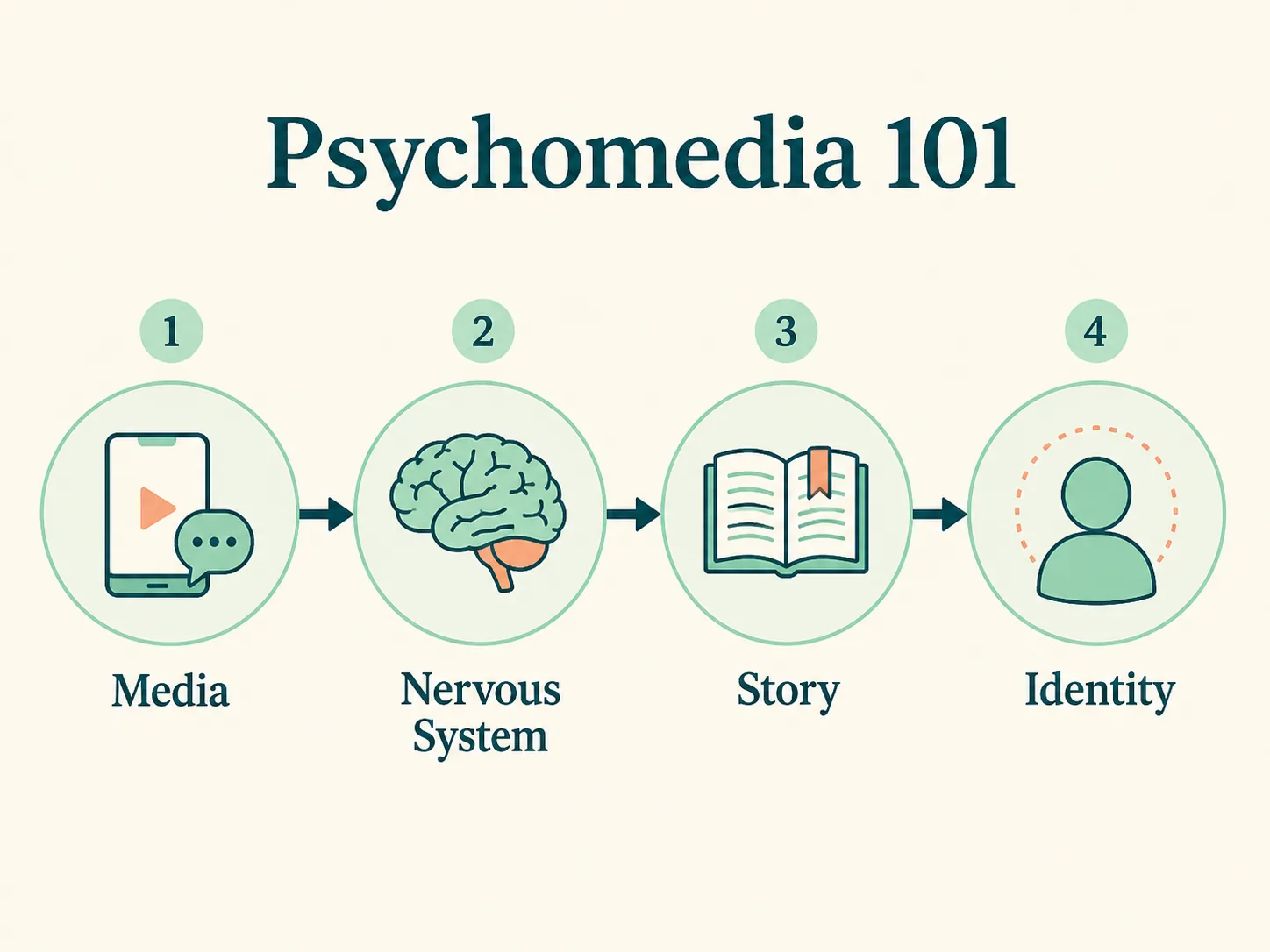
Media enters the mind as stimulus.
Repeated stimulus becomes state.
Repeated state becomes story.
Repeated story becomes identity.
06Where Psychomedia Comes From
Psychomedia did not come from one discipline.
It drew on trauma theory, linguistics, media analysis, political critique, semiotics, and direct observation of how language, media, and trauma converge in lived experience.
Several thinkers shaped its foundations. George Orwell clarified how language can become a tool of control. Bessel van der Kolk showed how trauma reshapes the nervous system, perception, memory, and behavior. Stephen Krashen’s model of language acquisition showed how environment, safety, and repeated exposure shape what the mind absorbs. Michael Greger’s inheritance logic helped frame how patterns can pass through generations not only through genes, but through conditions, behaviors, and repeated environments.
Media theory, propaganda analysis, and symbolism added another layer: the study of how images, stories, repetition, spectacle, and cultural signals train perception.
But Psychomedia is not simply a combination of these influences. It is a framework built from seeing the same pattern across fields that usually remain separate.
Put simply:
Orwell, van der Kolk, Krashen, and Greger gave fragments. Psychomedia built the framework.
Together, these articles explain the central idea: media is not only something people consume. It is one of the environments through which modern consciousness is shaped.
Mint Achanaiyakul is a cognitive theorist and founder of Psychomedia. Her work explores how language, media, trauma, and systems of control shape human psychology.